



Market Entry Services
![Market Entry Services: From Strategy to Scalable Growth [2026 Edition]](https://stratikasolutions.com/wp-content/uploads/2025/06/Market-Entry-Services-Cover-by-Startika-Solutions-1170x547.png)
Market Entry Services: From Strategy to Scalable Growth [2026 Edition]
Market entry services are not about simply selling abroad. They are about building commercial success inside a new market reality. Every geography brings different buyer behavior, different trust signals, new competitive pressures, substitute alternatives, pricing expectations, and operational complexity. Expansion fails when these forces are underestimated or misunderstood.
That is why market entry services exist. Not to make international growth look structured, but to make it economically viable and scalable. At Stratika Solutions, we approach market entry as a disciplined system that connects strategy, validation, go-to-market architecture, performance measurement, and controlled scale.
This guide explains what market entry services truly involve, why expansion fails even when the product is strong, and how to structure entry so demand is built with clarity, control, and commercial logic rather than assumption.
What Market Entry Services Really Mean
“Market entry services” should not mean a slide deck and a few generic recommendations. Real market entry services combine three things:
Decision structure(choosing the right market and entry approach)
Demand creation(positioning, messaging, channels, proof)
Execution and measurement(launching, learning, optimizing, scaling)
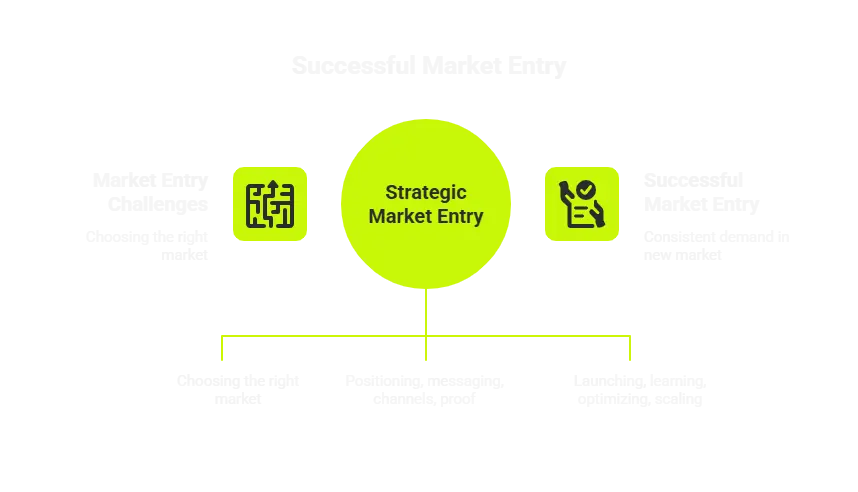
In other words, market entry services are the bridge between “We want to expand” and “We’re generating consistent demand in a new market.”
This is especially important for growing companies. Most SMEs don’t have a whole in-house team for research, brand strategy, performance marketing, conversion optimization, analytics, CRM, and local execution. So the risk isn’t just “wrong strategy.” The risk is fragmentation: different vendors pulling in various directions, with no single entity owning the outcomes.
Why Market Entry Fails Even When the Product Is Strong
Most failed expansions don’t fail because the product is weak. They fail because the company misreads how demand is created in the new market.
- Assuming demand exists (when the market needs education)
If buyers don’t recognize the problem you solve — or don’t trust a new entrant — demand stays theoretical. You need education, proof, and a clear reason to switch.
- Copy-pasting messaging across markets
What works at home often fails abroad because motivations, objections, and cultural “decision language” change. Local buyers may require different proof, comparisons, and framing.
- Underestimating competitors and substitutes
You don’t just compete with similar brands. You compete with habits, local defaults, informal alternatives, and “doing nothing.” Winning often means making switching feel safe and obvious.
- Treating operational friction as an afterthought
Certifications, data rules, distribution constraints, service expectations, returns, and partner dependencies can slow entry or quietly destroy margins. Market entry requires commercial realism.
The pattern is consistent: companies launch too early, spend too broadly, and learn too slowly. Global investment conditions are becoming more fragmented and less predictable, which is why structured market entry and investment facilitation are increasingly important, as highlighted in UNCTAD’s World Investment Report 2024.

A Practical Market Entry Framework (Strategy → Execution)
We prefer frameworks that are both structured and usable. Here’s a practical process Stratika uses to reduce risk and accelerate traction.
Step 1: Market Attractiveness Screening (Should We Even Go There?)
Goal: identify markets worth deeper investment.
We look at:
Demand signals and early intent
Competitor intensity and differentiation gaps
Channel accessibility (search, marketplaces, partners)
Price expectations and purchasing behavior
Operational/regulatory friction (where relevant)
Output: a shortlist of 1–3 priority markets, not a long “maybe” list.
Step 2: Commercial Viability (Can We Win Profitably?)
Market size doesn’t pay bills — margins do.
We pressure-test:
Customer acquisition economics (CAC reality)
cost structure and margin durability
Payback period and cash-flow timing
Operational feasibility and service expectations
Output: a go/no-go and a realistic 90-day entry plan.
Step 3: Positioning & Messaging (Why Will Local Buyers Choose You?)
This is where marketing-led market entry becomes powerful.
We define:
Target segments that actually buy
The “job to be done” locally
The real alternatives (including habits)
Proof and credibility signals that reduce perceived risk
Output: positioning, core messaging, landing page structure, and content angles.
Step 4: Entry Mode Selection (How do we enter with the proper control?)
Entry can be:
Direct export
Distributor-led
Partnerships
Digital-first
Hybrid models
Each mode changes speed, control, risk exposure, and marketing investment. We choose the mode that best fits your capabilities and market realities.
Output: entry mode + channel strategy + responsibilities.
Step 5: Validation Before Scaling (Prove it before you go big)
This is where market entry services save money and time.
We run controlled validation through:
Pilot launches
Targeted campaigns
Messaging tests
Segment testing
Regional rollouts
Output: evidence-based scaling plan (what to double down on, what to stop).

What Stratika’s Market Entry Services Include
Who We Partner With
Stratika Solutions supports ambitious brands across food and beverage, retail, health technology, education, and consumer products as they expand into new markets. Our experience includes working with a Brazilian perfumery, a Beirut textile art studio, Colombian coffee brands, a European bakery and café chain, a South African e-learning platform, a Swiss diabetes application, a Hungarian frozen foods brand, a cherry liqueur bar concept, and coffee chains operating in Romania and Ukraine. What these clients have in common is not their industry. It is their ambition to grow beyond their home market and their need for a structured, commercially sound path to international expansion.
Stratika Solutions supports market entry end-to-end. Not as disconnected services, but as an integrated system designed to create demand and scale with control.
1. Strategic Architecture
This phase eliminates structural risk before capital is deployed.
Strategic Clarification and Brand Audit
We define what your company stands for in competitive terms. We identify positioning weaknesses, commoditized narratives, and credibility gaps that would undermine international expansion.
Market Structure and Competitive Intelligence
We analyze pricing dynamics, distribution control, substitute behavior, regulatory exposure, and category power structures.
Segment Definition and Buyer Logic Mapping
We define commercially viable segments based on real switching behavior, trust requirements, risk perception, and purchasing logic.
Positioning Architecture
We build a differentiated value structure adapted to the decision psychology of the target market.
When required, we support naming refinement and brand system alignment to ensure immediate credibility in premium or regulated markets.
2. Entry Architecture and Demand Structuring
Strategy becomes operational through structured entry design.
Channel and Distribution Structuring
We design entry models, including direct, distributor, partnership, hybrid, or digital-first approaches, balancing speed, control, margin durability, and capital exposure.
Go to Market System Design
We architect the complete entry framework, including positioning deployment, acquisition sequencing, and conversion pathways aligned to commercial objectives.
Search and Demand Visibility Strategy
We structure discoverability based on actual buyer behavior, including localization logic and intent-based visibility architecture.
Controlled Validation Programs
We conduct structured pilot initiatives to validate messaging, segments, price sensitivity, and acquisition economics before scaling investment.
3. CTO Advisory and Technical Market Readiness
Expansion into regulated or digitally mature markets requires technical discipline.
CTO Level Technical Consulting
We assess and structure your digital infrastructure to ensure scalability, security, and operational integrity in new markets.
GDPR and Data Compliance Consulting for the European Union
We evaluate data handling practices, consent structures, tracking mechanisms, CRM architecture, and cross-border data flows to ensure alignment with GDPR requirements.
International Regulatory Technology Mapping
Beyond the European Union, we analyze relevant data protection and digital compliance frameworks applicable to the target market.
Digital Infrastructure Readiness
We review hosting structures, platform architecture, cybersecurity posture, analytics configuration, and technical dependencies that may affect expansion.
Technical misalignment can silently destroy international growth. We prevent that before exposure increases.
4. Commercial Performance Governance
Launching does not equal winning. Governance determines sustainability.
Revenue and Margin Modeling
We pressure test acquisition costs, contribution margins, and capital payback under realistic market conditions.
Performance Measurement Frameworks
We design executive dashboards tied to capital allocation decisions, not superficial indicators.
Conversion and Friction Optimization
We eliminate structural inefficiencies before scaling acquisition spend.
Customer Journey Alignment
We synchronize marketing, sales, and operational touchpoints to reflect real buyer behavior in the new market.
5. Advisory, Capability Development, and Executive Support
Market Entry Strategy Advisory
Executive-level workshops and structured decision frameworks guiding leadership through expansion sequencing and risk exposure.
Internal Enablement Programs
We develop internal capability so teams can operate consistently across markets.
Ongoing Strategic Audits
Periodic structural evaluations to maintain alignment across positioning, distribution, compliance, and performance.
Customer Experience and Retention Structuring
We refine onboarding systems and service flows to convert early traction into durable growth.

A Structured 90 Day Market Entry Framework
Days 1 to 15
Market prioritization
Competitive intelligence
Initial positioning hypothesis
Entry model selection
Technical and compliance audit, including GDPR exposure review
Days 16 to 45
Positioning deployment
Channel architecture confirmation
Digital infrastructure adjustments
Tracking, CRM, and consent framework alignment
Days 46 to 75
Segment validation
Messaging refinement
Acquisition cost benchmarking
Compliance verification before scale
Days 76 to 90
Capital allocation to validated segments
Conversion optimization
Repeatable acquisition system design
Infrastructure stress testing for scale readiness
This is disciplined market entry, not speculative expansion.

How Stratika Structures Market Entry Services
We integrate strategic advisory, commercial modeling, channel structuring, CTO-level technical consulting, GDPR and regulatory alignment, validation frameworks, and performance governance into one connected expansion system. Market entry services should reduce risk, not increase complexity.
When expansion is supported by strategic clarity, technical compliance, and commercial validation, growth becomes controlled, defensible, and repeatable rather than uncertain.