


Trade Marketing
![Trade Marketing Explained: How Brands Win Inside Distribution Channels [2026 Edition]](https://stratikasolutions.com/wp-content/uploads/2025/06/Trade-Marketing-cover-by-Stratika-Solutions-1170x547.webp)
Trade Marketing Explained: How Brands Win Inside Distribution Channels [2026 Edition]
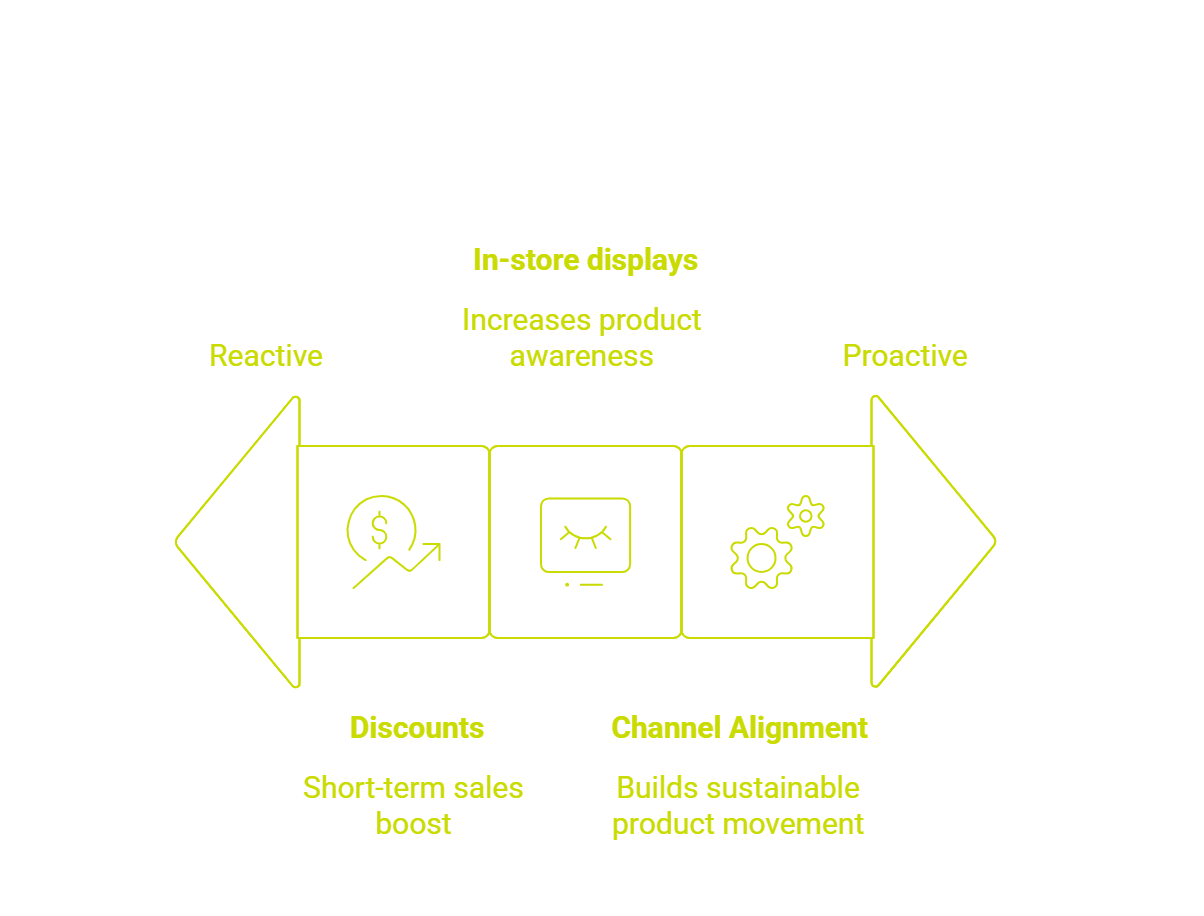
Trade marketing is often misunderstood. Many companies reduce trade marketing to promotions, discounts, or in-store visibility. While those activities are part of it, they are not the core. At its foundation, trade marketing is the system a company uses to create demand, preference, and momentum inside its distribution channels, not only at the consumer level. When executed well, it aligns brand strategy, channel economics, and buyer behavior so that products move not because they are pushed, but because the channel is designed to support them.
Trade Marketing’s Role Between Marketing and Sales
This channel-focused marketing function sits between brand marketing and sales. It concentrates on how products are positioned, supported, and prioritized across distributors, retailers, platforms, and partners. Instead of asking, “How do we convince the consumer?”, the focus shifts to a different question: “How do we make the channel want to sell us?” This includes decisions around pricing logic, incentives, visibility, assortment, and communication materials. When this approach is designed properly, sales teams face less resistance, distributors commit more resources, and demand becomes more predictable.
Channel Marketing vs Brand and Digital Marketing
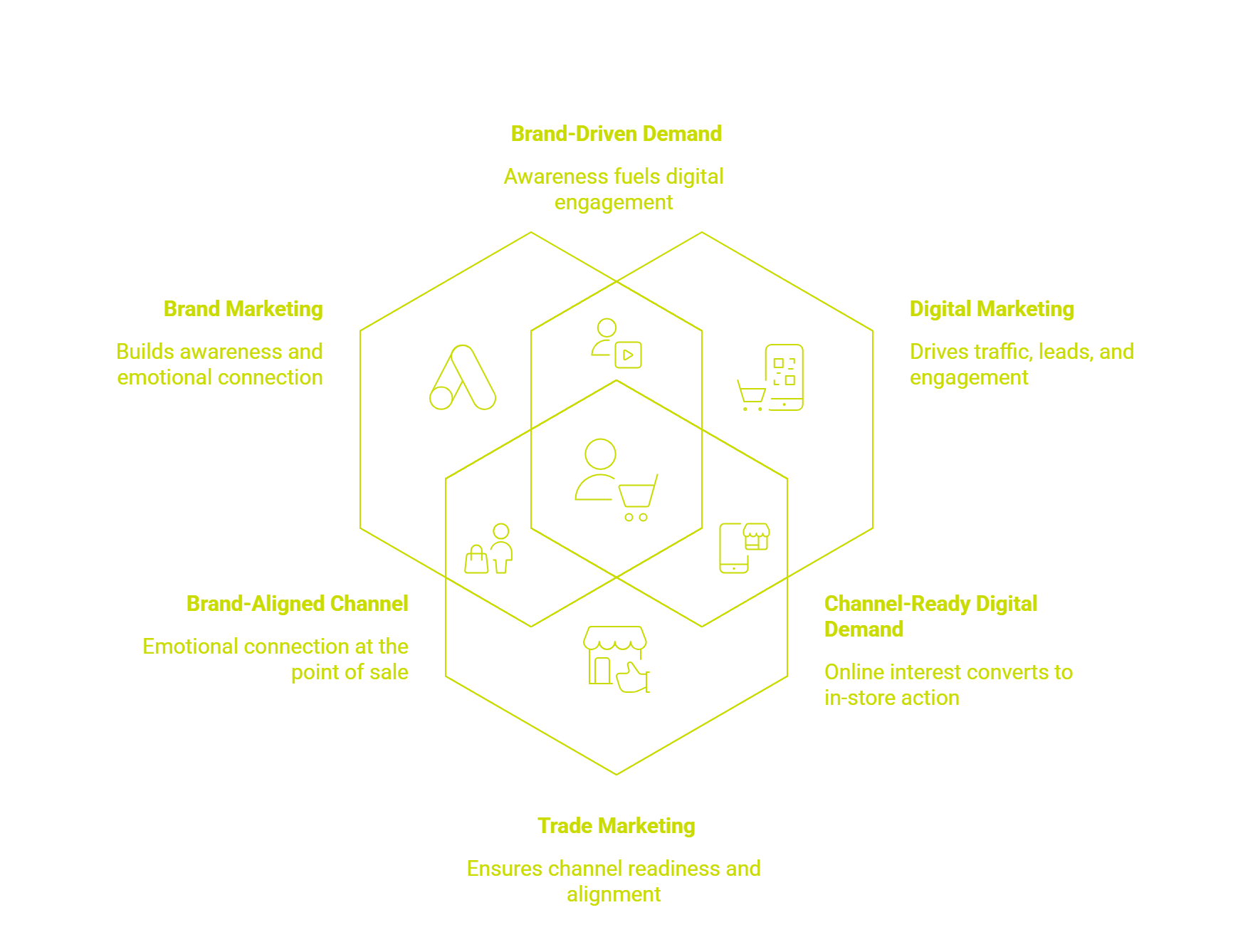
Brand marketing builds awareness and emotional connection, and the right marketing strategy & analytics can ensure these efforts translate into measurable momentum. Channel-focused execution translates that demand into commercial reality inside the sales network. A strong brand without proper channel alignment often struggles at the point of sale. Likewise, a strong digital presence without channel support can generate interest that never converts. Integrating digital marketing services with channel execution ensures that online demand generation actually converts into in-store sales. Effective trade marketing ensures that when demand appears, the channel is ready and aligned to capture it.
How Channel Execution Works in Practice
In practice, this approach shapes how products are introduced, prioritized, and sustained within distribution networks. It influences how sales arguments are framed, how promotions are structured, and how partners perceive risk and opportunity. Instead of relying on generic discounts, effective execution clarifies why a product deserves shelf space or platform visibility, how it compares to existing alternatives, and how partners benefit commercially from supporting it. This is why trade marketing is not a campaign; it is a decision system. This systemic perspective is also reflected in how teams develop internal capabilities through consulting & training, particularly when structured channel decision-making needs to be built over time.
Channel Strategy in Fast-Growing Markets Like Vietnam
This distinction becomes especially visible in fast-growing markets like Vietnam. Many Vietnamese companies already perform channel activation activities without formally naming them. Promotions are launched, distributors are supported, and channels are activated, yet these efforts are often disconnected from positioning and long-term demand creation. As a result, volume may grow temporarily, but margins, brand strength, and partner commitment remain fragile. Strong brand strategy & identity work lay the foundation for consistent positioning across channels and support long-term partner trust. This pattern frequently appears in international expansion efforts discussed in our guide on market entry marketing for Vietnamese companies, where channel decisions often determine whether expansion scales or stalls.
Why Trade Marketing Often Fails
Failures usually come from execution without alignment. Promotions are launched without a clear value narrative. Incentives are offered without understanding long-term margin impact. Channel strategies are copied from competitors without validating whether they fit the brand or the market. When this happens, costs increase, but demand does not. Over time, distributors lose interest, and growth becomes reactive rather than controlled. This challenge is closely linked to the broader issue of why market entry fails even when products are strong.
Marketing and International Expansion
When companies expand internationally, channel alignment becomes even more critical. Domestic assumptions rarely hold abroad. Distribution structures, decision-makers, trust signals, and purchasing logic change. Channel strategies must be rebuilt, not reused. This is why trade marketing increasingly overlaps with market entry strategy and validation, especially in regions with complex distribution ecosystems such as Southeast Asia.

When Trade Marketing Becomes a Competitive Advantage
Trade marketing becomes a competitive advantage when it is connected to positioning, data, and long-term strategy. Companies that treat it as a system rather than a support function gain control over growth instead of reacting to it. They reduce dependency on discounts, improve partner loyalty, and scale without eroding margins. Strong channel execution helps companies move from volume-driven growth to sustainable, demand-led expansion.
What This Means for Growing Brands
Trade marketing is not about pushing products harder. It is about designing the conditions in which products sell naturally inside the channel. As markets become more competitive and distribution becomes more complex, this discipline shifts from an operational role to a strategic one. Growing brands that treat channel execution as a system rather than a set of isolated activities move faster, learn more efficiently, and scale with greater control. Those who do not often mistake motion for progress and volume for sustainable growth.